

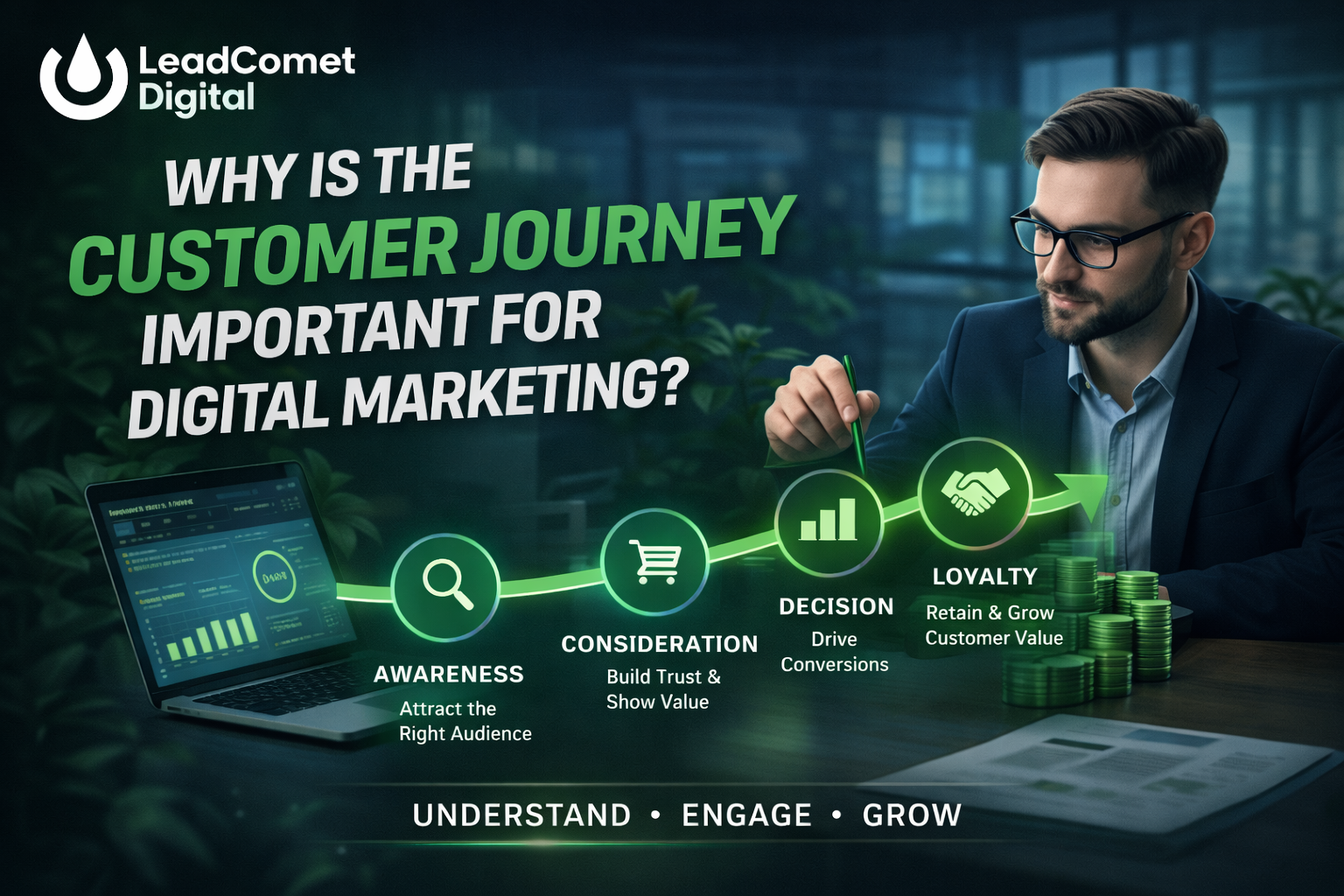
If you want better results from your digital marketing, you need to understand how people move from first impression to final decision. The customer journey shows you what your audience thinks, feels, needs, and expects at each stage before and after a purchase.
Once you understand that path, you can create smarter campaigns, stronger content, and a smoother experience that turns attention into trust. Read on as we discuss why the customer journey so crucial for digital marketing.
What The Customer Journey Means In Digital Marketing
The customer journey is the full path a person takes when interacting with your brand across digital channels. It usually begins with awareness, moves through research and consideration, then reaches purchase, retention, and loyalty.
In digital marketing, this journey includes every touchpoint that influences a decision. That can include search results, social media posts, blog articles, landing pages, product pages, reviews, email campaigns, checkout pages, and post-purchase messages.
When you understand this path, you stop treating marketing like a series of isolated tasks. You start to see how each channel supports the next step, and how a single weak touchpoint can reduce the impact of the whole campaign.
This matters because buyers rarely make instant decisions, especially in competitive markets. Most people compare options, read reviews, revisit sites, and think carefully before they commit.
A clear view of the customer journey helps you match your message to the right moment. Instead of pushing the same pitch to everyone, you can guide people with content that’s relevant to where they are and what they need next.
That shift makes your marketing more useful and more persuasive. It also helps you spend less time guessing and more time improving the parts of the experience that actually drive results.
Why Understanding Customer Behavior Improves Marketing Results
When you study the customer journey, you get a clearer picture of how people behave before they buy. You begin to see what captures attention, what creates doubt, and what finally moves someone to act.
That insight makes your marketing more accurate because it is based on real behavior rather than assumptions. You can identify which pages people visit first, where they hesitate, how often they return, and which touchpoints have the strongest effect on conversion.
Tools like Viewifi can help businesses gain better visibility into digital interactions and understand how audiences engage with online experiences.
This kind of visibility helps you refine your audience targeting. Instead of using broad messages for everyone, you can shape campaigns around specific questions, concerns, and decision-making patterns.
It also helps you recognize different motivations across different segments. A first-time visitor may need education and reassurance, while a returning visitor may need proof, pricing clarity, or a reason to act now.
Without this level of understanding, your marketing can become disconnected from what people actually want. You may publish content that sounds good internally but fails to answer the real concerns buyers have in the middle of the journey.
When your marketing reflects actual customer behavior, it becomes easier to increase engagement and reduce waste. You create messages that feel timely, helpful, and relevant, which builds people’s confidence in your brand and improves performance across the funnel.
How The Customer Journey Helps You Create Better Content
Content performs better when it matches the stage of the journey your audience is in. Someone discovering your brand for the first time needs a different message than someone comparing your offer to a competitor’s.
This is why customer journey thinking is so valuable for content strategy. It helps you decide what to say, when to say it, and where each piece of content fits in the larger path to conversion.
Understanding audience interactions can also improve content planning. Tools like Vieworaa can help businesses organize digital insights when creating more relevant marketing materials.
At the awareness stage, your content should educate and attract attention. Blog posts, short videos, search-optimized pages, and introductory guides can help people understand a problem and recognize that your brand has useful answers.
At the consideration stage, readers usually want more depth and clarity. They may need comparisons, FAQs, product benefits, case studies, or practical explanations that reduce uncertainty and show why your offer is worth serious attention. Choosing the right design elements, such as fonts from resources like Fontono, can also make content more engaging and easier to consume.
At the decision stage, your content should remove friction and build trust. Strong product details, transparent pricing, helpful reviews, and clear calls to action can help users feel ready to move forward.
Post-purchase content matters, too, because the journey does not end when the transaction occurs. Helpful onboarding, support content, and follow-up emails can improve satisfaction and increase the chance of repeat business, referrals, and long-term loyalty.
Why Journey Mapping Helps You Find Pain Points Faster
One of the biggest reasons the customer journey matters is that it helps you find friction points before they become expensive problems. A journey map shows where people slow down, lose confidence, or abandon the process altogether.
This can happen at many stages of the digital experience. A confusing menu, a weak landing page, a slow mobile site, unclear product information, or a complicated checkout can break momentum and push people away.
When you review the journey closely, those weak spots become easier to identify. You are no longer looking only at final sales numbers, because you are also paying attention to the steps that lead up to those outcomes.
That is important because poor performance is often caused by small obstacles rather than a bad offer. Many brands lose conversions because they fail to notice the details that frustrate users during key moments of decision-making.
Journey analysis helps you catch those details early. You can improve navigation, simplify messaging, eliminate unnecessary steps, and make the experience feel more intuitive from the first click to the final action.
The result is a smoother path that respects the user’s time and attention. When people feel less friction, they are more likely to stay engaged, trust your brand, and keep moving through the funnel rather than drop out.
The Link Between Customer Journey And Higher Conversions
A strong customer journey supports conversions by guiding people toward action in a logical, reassuring way. It reduces confusion, answers objections, and helps users feel ready to take the next step.
Many businesses focus heavily on traffic and forget that traffic alone does not create growth. If visitors arrive but do not find the information, reassurance, or ease they need, your conversion rate will stay lower than it should.
Customer journey work helps fix that by improving the experience around intent. You can identify the moments when people need social proof, better product images, simpler forms, stronger value statements, or more transparent delivery information.
This makes your marketing more conversion-focused without making it aggressive. Instead of pressuring people, you remove the reasons they hesitate and give them a clearer path forward.
It also helps you optimize micro-conversions that support larger goals. Actions like clicking a product page, signing up for email, using site search, or adding an item to the cart are often signs that a person is progressing through the journey.
When you improve these smaller steps, final conversions often increase. That is why the customer journey is so important in digital marketing: it helps you build momentum at every stage, rather than hoping one message will do all the work.
How Personalization Becomes More Effective With Journey Insight
Personalization works best when it responds to where a person is in the journey. If you treat every visitor the same, your messaging becomes generic and less useful.
Journey insight helps you tailor communication based on context, behavior, and intent. You can show different offers, content, or reminders to first-time visitors, returning readers, active shoppers, and repeat customers.
This improves relevance because not everyone needs the same information at the same time. A new visitor may need a simple explanation, while a more engaged visitor may respond better to proof, urgency, or specific product details.
Personalization also improves the customer experience when it feels helpful rather than intrusive. When people see content that reflects their needs, the brand feels more attentive and easier to trust.
That matters in crowded digital spaces where attention is limited and switching costs are low. If your content feels irrelevant or repetitive, people can quickly move to another brand that seems to understand them better.
Journey-based personalization helps prevent that drift. It turns your marketing into a guided experience that feels more aligned with the customer’s goals, increasing engagement, strengthening loyalty, and driving stronger results over time.
Why The Customer Journey Strengthens Channel Strategy
Digital marketing often spreads across several channels at once, including search, social, email, paid ads, and your website. The customer journey helps you understand how those channels work together instead of judging them in isolation.
This is important because a buyer may discover you on one platform, compare options on another, then convert later through a direct visit or email. If you only measure the final click, you may misunderstand which channels are truly influencing outcomes.
Journey analysis gives you a more complete view of channel performance. You can see which sources build awareness, which ones nurture consideration, and which touchpoints support final action.
Understanding how audiences interact across different platforms can also improve your channel decisions. A Titok Viewer can help analyze social content engagement patterns and provide insights into how users interact with digital platforms.
That knowledge helps you allocate budget more effectively. You stop overvaluing channels that only capture the last step and start investing more wisely across the full customer path.
It also improves message consistency across platforms. When you understand the role of each channel, you can make sure your content feels connected rather than repetitive or fragmented.
A stronger channel strategy leads to better experiences and more efficient campaigns. Instead of pushing disconnected tactics, you create a system in which every touchpoint supports the next stage and helps move the customer closer to a confident decision.
How Customer Journey Knowledge Improves Customer Experience
Customer experience is one of the clearest outcomes of strong journey mapping. When you know what customers are trying to achieve at each stage, you can make the experience easier, clearer, and more satisfying.
That can affect everything from website structure to message timing. It shapes how you present offers, how you handle questions, how quickly users find answers, and how supported they feel after they buy.
A consistent visual experience also improves how customers interact with your brand. Resources like Fontava can help marketers create clearer content presentations that make digital experiences easier to understand.
Poor experience creates friction that weakens even strong marketing campaigns. If the path feels stressful, confusing, or overly complicated, buyers may leave with a negative impression even if they were interested at first.
Journey knowledge helps you prevent that outcome. It encourages you to think from the customer’s point of view rather than from the company’s internal priorities, which often leads to more customer-centered decisions.
This shift can improve satisfaction, retention, and word-of-mouth over time. People are more likely to return to brands that make their lives easier, and the customer journey gives you a practical framework for delivering that kind of experience consistently.
Why It Supports Better Decision Making Across Teams
The customer journey is not only useful for marketers. It also helps sales, design, support, product, and leadership teams understand how their work affects the full customer experience.
That shared view improves decision-making because everyone can see the same path from the customer’s perspective. Instead of optimizing separate tasks in isolation, teams can work together around a common goal.
For example, marketing may drive traffic effectively, but design may need to improve usability, and support may need to respond more quickly after purchase. Journey mapping makes those connections visible and helps teams solve problems more collaboratively.
This is especially helpful in businesses where customer experience spans several departments. Without a shared journey view, teams may unintentionally create gaps, duplicate messages, or conflicting priorities, which can weaken results.
A strong journey framework encourages cross-functional alignment. It helps teams ask better questions, prioritize improvements more intelligently, and focus on the moments that matter most to customers.
That kind of alignment often leads to better performance because the customer experiences the brand as one connected system. When internal teams understand their role in the journey, the business becomes more responsive, more efficient, and more consistent in its marketing efforts.
The Role Of Data In Understanding The Customer Journey
You cannot improve the customer journey well if you are guessing. Good digital marketing relies on data to show how people move through your site, where they engage, and where they leave.
This data can come from analytics platforms, heatmaps, session recordings, surveys, customer feedback, email metrics, and conversion reports. Each source adds a different layer of understanding to the journey.
Quantitative data shows you what is happening at scale. It can reveal traffic patterns, bounce rates, exit points, page performance, and conversion trends that help you identify where the journey is working or breaking down.
Qualitative data explains why those patterns may exist. Feedback, interviews, support messages, and survey responses often reveal emotional reactions, frustrations, and unmet expectations that numbers alone cannot fully explain.
Tools like TikFCounter can also help businesses understand engagement behavior and use audience insights to improve digital strategies.
When you combine both types of data, your decisions become more grounded. You can fix real problems, support strong pages, and build campaigns that reflect both behavior and customer sentiment.
This makes your digital marketing far more strategic. Instead of reacting to isolated metrics, you build a clearer picture of how people experience your brand from first interaction to long-term relationship, which leads to smarter improvements and stronger outcomes.
Why The Customer Journey Matters After The Purchase
Many marketers focus too heavily on getting the sale and ignore what happens afterward. That is a mistake because the customer journey continues after purchase, and this stage has a major impact on retention and loyalty.
The post-purchase experience shapes how people feel about the decision they just made. If the process is smooth, helpful, and reassuring, they are more likely to stay satisfied and buy again.
This stage includes onboarding, support, delivery communication, follow-up emails, feedback requests, and educational content. These touchpoints can either reinforce trust or create frustration that weakens the relationship.
A strong post-purchase journey reduces buyer’s remorse and increases confidence. It helps customers get value faster, which is one of the biggest drivers of repeat business and positive recommendations.
It also gives you another opportunity to personalize communication. You can suggest related products, offer helpful usage tips, and create experiences that feel relevant instead of generic.
When you treat the journey as a long-term relationship rather than a one-time sale, your marketing becomes more sustainable. Loyal customers often cost less to retain than new customers cost to acquire, so improving this stage can strengthen both revenue and profitability.
How Journey Thinking Gives You A Competitive Advantage
In crowded markets, many brands offer similar products, similar prices, and similar promises. The customer journey can become a real differentiator because experience often influences the final choice as much as features do.
If your brand feels easier to understand, easier to navigate, and easier to trust, people are more likely to choose you. That advantage grows when competitors focus only on promotion and ignore the quality of the path leading to conversion.
Journey thinking helps you compete through clarity and usefulness. You are not simply trying to be louder than other brands, because you are building an experience that feels more thoughtful at every stage.
This matters especially when buyers compare several options before deciding. The brand that communicates well, removes friction, and supports confident choices is more likely to win the sale.
It also helps you adapt faster when behavior changes. When you regularly reflect on your journey, you are more likely to notice new expectations, shifting preferences, and weak points before they hurt performance.
That makes your marketing more resilient and more responsive. Over time, brands that understand the customer journey well tend to make smarter improvements, build stronger trust, and create experiences that are harder for competitors to copy quickly.
Common Mistakes Businesses Make When Ignoring The Journey
One common mistake is treating every customer the same, regardless of intent. This usually leads to generic content, weak targeting, and messaging that does not match what people need at specific stages.
Another mistake is focusing only on acquisition metrics while ignoring the quality of the actual experience. High traffic can look impressive, but it means very little if users leave confused, frustrated, or unconvinced.
Some businesses also assume they already know what customers want without verifying it through behavior and feedback. That mindset often leads to internal guesswork, missed pain points, and campaigns that sound polished but fail to convert well.
A related mistake is neglecting mobile experience and usability. Many journeys now begin and continue on phones, so slow pages, awkward layouts, or difficult forms can quickly degrade performance.
Companies also lose momentum when teams work in silos. If marketing, design, and support are not aligned, the customer can experience mixed messages and unnecessary friction across touchpoints.
Ignoring the customer journey often leads to hidden losses over time. You may not notice immediately, but lower trust, weaker engagement, reduced retention, and missed conversion opportunities can quietly limit growth until the business decides to improve the journey as a whole.
How To Start Improving Your Customer Journey Today
You do not need a massive system to begin improving the customer journey. You can start by identifying the key stages your audience moves through and listing the main touchpoints they encounter along the way.
From there, review what customers see and experience at each stage. Ask whether the message is clear, whether the next step feels obvious, and whether anything creates doubt, delay, or frustration.
Use analytics and customer feedback to support your review. Look at traffic sources, top exit pages, time on site, conversion paths, survey responses, and support questions to find areas that need attention first.
Then prioritize high-impact fixes rather than trying to change everything at once. Small improvements in navigation, page speed, messaging, product clarity, or email timing can create meaningful gains across the funnel.
It also helps to involve multiple teams in the process. When marketing, design, product, and support share insight, the journey becomes easier to understand and improve from multiple angles.
The key is to treat the journey as an ongoing process, not a one-time project. Customer expectations change, channels evolve, and behavior shifts over time, so the brands that keep learning and adjusting are the ones most likely to improve results consistently.
Conclusion
The answer to why the customer journey is important for digital marketing is simple: it helps you understand how people actually move from awareness to action and from purchase to loyalty. When you understand that path, you can create more relevant content, improve customer experience, reduce friction, personalize communication, and make smarter decisions across channels.
The customer journey turns marketing from guesswork into strategy. It shows you what customers need at each stage, where they get stuck, and what helps them move forward with confidence.
That is why businesses that pay attention to the journey often see stronger conversions, better retention, and more efficient campaigns. If you want your digital marketing to work harder and feel more useful to the people you serve, start by improving the journey they take with your brand.